Salt and Sodium in Israeli Food: What Adds Up Before the Saltshaker
To reduce sodium, start with the bread, cheese, and sauces you eat regularly. Israel's red warning symbol flags a high concentration, but the nutrition panel and your serving size show how much sodium actually reaches your plate.
Adi Way Editorial TeamPublished:
The day starts with bread, not a salty snack
Salt brings chips and pickles to mind more readily than a breakfast sandwich. Yet bread, cheese, processed meat, prepared sauces, and soup powders can all appear in the same day. Each may add sodium before you touch the saltshaker.
The World Health Organization lists bread, processed meat, and condiments among dietary sodium sources. That does not make every loaf equally salty or mean sandwiches need to disappear. Ask which product you buy, how much you eat, and how often it appears. A regular food deserves attention even when it does not taste especially salty.
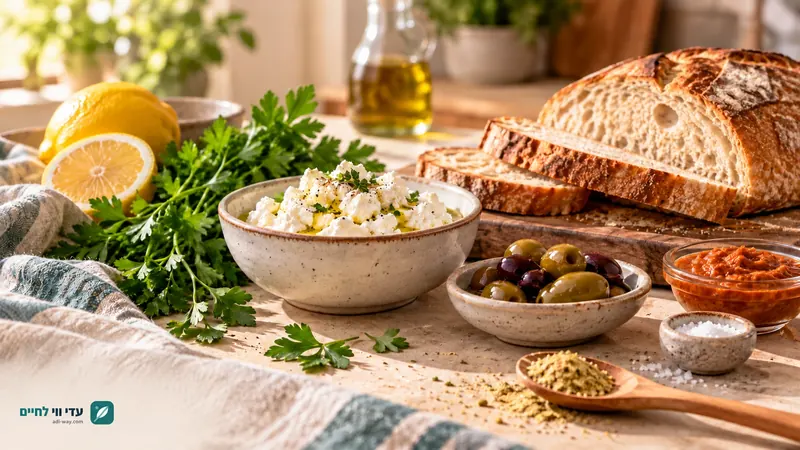
Start with one familiar meal: bread, spread, cheese, olives, and seasoning. No single ingredient needs to become the culprit. Look at the combination, then find one straightforward change that preserves the meal you enjoy.
Sodium and salt are different numbers
Sodium is an essential mineral; table salt contains sodium and chloride. WHO recommends that adults consume less than 2,000 milligrams of sodium daily, equivalent to less than 5 grams of salt. That includes sodium already in food, as well as salt added during cooking or at the table.
Excess sodium raises blood pressure, which increases cardiovascular risk. Reducing it is about changing a repeated pattern. A salty meal cannot diagnose your blood pressure, and feeling well does not replace a measurement when one is needed.
Keep the units straight, too. Milligrams of sodium and grams of salt are not interchangeable. When comparing Israeli products, use the sodium line consistently rather than switching between the two measures.
What the red symbol actually means
According to the Israeli Ministry of Health's explanation of red food symbols, the sodium thresholds introduced in January 2021 are 400 milligrams per 100 grams of solid food and 300 milligrams per 100 milliliters of liquid food. Products covered by the labeling requirement must carry the relevant symbol when they exceed the threshold.
This describes concentration, not your individual meal. It does not account for eating a little of one food and a lot of another. The ministry also cautions that having no red symbol does not certify a product as healthy. Use the symbol to prompt a closer look at the panel and portion.
You do not need to memorize the regulations at the supermarket. When two products serve the same purpose, turn their packages around and compare sodium on the same basis. The warning can focus your attention without turning shopping into an exam.
Translate the panel into your portion
Values per 100 grams let you compare similar foods fairly. Then calculate your serving: sodium per 100 grams, multiplied by the serving's weight, divided by 100. If the package also gives a per-serving value, check whether its serving resembles yours.
Here is an arithmetic example, not a description of a specific product. A food containing 600 milligrams of sodium per 100 grams provides 180 milligrams in a 30-gram serving. A 60-gram serving provides 360 milligrams. The package is unchanged, but the amount you eat changes the result.
For soup powder or concentrated sauce, check whether the figures describe the product as sold or after preparation. Do not compare dry powder directly with prepared soup without considering the instructions. Our food-label guide also explains how to examine ingredients your gut may not tolerate well.
Make small changes in a familiar kitchen
Food Standards Scotland notes that soup, pasta sauces, and bread products can vary in salt depending on the recipe. Compare within a category before removing the entire category. You could choose a lower-sodium cheese while keeping your usual sandwich, or change the sauce rather than rebuild dinner.
- For soup, try developing flavor with vegetables and herbs, then reconsider how much powder you need.
- With prepared sauce, measure your usual pour and compare a lower-sodium alternative.
- In a sandwich, reconsider combining processed meat, salty cheese, and pickles.
- At the table, taste before automatically adding salt.
The British National Health Service recommends herbs and spices as alternatives to extra salt. With reflux or a sensitive gut, however, lemon, chili, and garlic need not be your replacements. Use seasonings you already tolerate. Homemade food can be salty, and packaged food can be useful. Composition and quantity tell you more than the image a food projects.
If your diet is restricted, avoid cutting everything
If gut symptoms already limit your food choices, do not add a broad list of exclusions without considering what remains. A dietitian can help make a targeted substitution while preserving protein, energy, and variety. Our discussion of ultra-processed food and supermarket choices puts individual labels in a wider context.
Salt substitutes are not automatic solutions either. WHO's recommendation on potassium-containing substitutes excludes people with kidney impairment or other conditions affecting potassium excretion. If you have kidney disease, take relevant medicines, or follow a medical diet, ask your care team before making that change.
For your next shopping trip, choose one task: compare one food you buy regularly and find an alternative you would happily keep eating. Once that choice becomes familiar, move to another product. Sodium reduction can fit your existing meals instead of requiring an entirely new kitchen.
This is general information and is not a substitute for personal advice from a doctor or dietitian.