Frozen or fresh vegetables: what is preserved and what to check on the package
Frozen vegetables can fit well into your diet, and fresh ones do not win every vitamin comparison. Choosing well also means looking at storage time, added ingredients, cooking, and how much actually reaches your plate, not just where the product sits in the supermarket.
Adi Way Editorial TeamPublished:
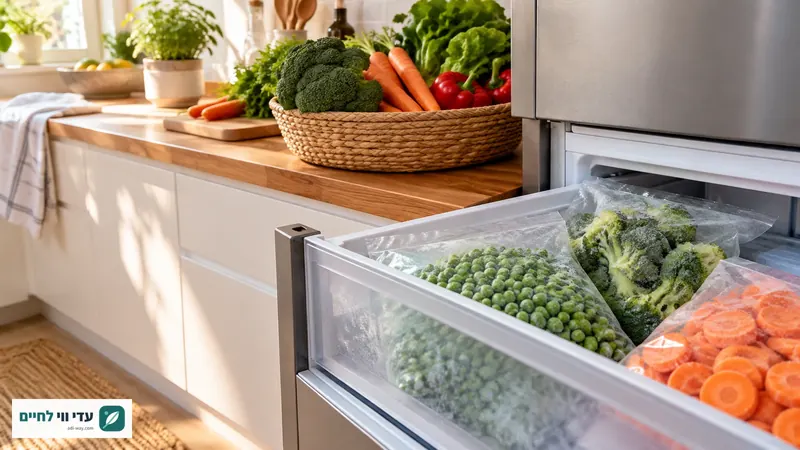
A bag of plain vegetables in the freezer is not equivalent to a prepared meal in sauce. Likewise, a fresh vegetable stored in the refrigerator for a long time is not identical to one eaten soon after purchase. The useful comparison is between foods as you will eat them, including preparation, not simply the words "fresh" and "frozen."
You can choose both. For soup, stew, or a quick side dish, frozen vegetables may save preparation. For salad and a crisp texture, you may prefer fresh. These are kitchen considerations, and they matter alongside nutritional composition: the choice should suit the meal you will prepare.
What vitamin studies found
A study by Ali Bouzari and colleagues, published in the Journal of Agricultural and Food Chemistry in 2015, compared vitamins in eight types of fruit and vegetables after refrigerated and frozen storage. The overall picture did not show a consistent disadvantage for frozen produce, but differences appeared by vegetable and vitamin, including lower beta-carotene in some samples.
A study that also compared fresh produce stored in the refrigerator, published in 2017 in the Journal of Food Composition and Analysis, examined vitamin C, beta-carotene, and folate. The additional group was refrigerated for five days to simulate home storage. Most comparisons found no significant difference; in some, frozen produce retained an advantage over stored fresh produce.
These are composition tests on specific produce, not proof of a long-term health advantage. Context matters too: according to the American Frozen Food Institute, both research teams worked with the Frozen Food Foundation. An industry connection does not invalidate the findings, but should be disclosed.
Blanching preserves quality but does not leave everything unchanged
According to the U.S. National Center for Home Food Preservation, many vegetables undergo blanching before freezing: brief heating intended to slow enzymatic processes that damage quality during storage. This partly explains why frozen vegetables can keep well; it does not show that they are "not really vegetables."
However, heat and contact with water can affect sensitive components. Prolonged storage of fresh produce and home cooking methods also change the result. Effects are not identical for every nutrient, so "freezing preserves all the vitamins" is too sweeping, just like the claim that it destroys them all.
Transport time, time on the shelf, and home storage vary. No fixed number of days describes every fresh vegetable.
Fresh, frozen, or canned: each has a place in the kitchen
Fresh vegetables suit meals where their natural flavor and texture matter. Plain frozen vegetables are convenient when you need only part of the package or want to skip some peeling and chopping. In a small household or out of season, they are a useful option, not a promise of a lower price.
Canned legumes and vegetables can fit in too. Check what has been added: salt, sugar, oil, or sauce. In a U.S. Agricultural Research Service study, draining and rinsing reduced sodium in the canned vegetables tested, but also some water-soluble components. It is therefore better to start by choosing a product that fits your needs than to assume rinsing removes all the salt.
Compare similar products and check whether the figures refer to the product as sold or after draining.
Four quick checks at the shelf
Start with the ingredient list. The difference between vegetables alone and a mix with salty sauce or a coating is a difference in the product itself, not only its taste. Next, compare sodium between similar options using the same weight basis.
Check added sugar and saturated fat too. In Israel, red labeling highlights high levels of sugars, sodium, or saturated fat. It helps identify an issue needing attention but does not replace the ingredient list and overall composition. For a structured approach, see how to read food labels.
Finally, check preparation and storage instructions. A package that looks convenient is not necessarily ready to eat without cooking. Make sure you have a way to prepare it as instructed.
From freezer to pot: nutritional quality is not food safety
EFSA emphasizes that frozen vegetables are not necessarily ready to eat as they are. Maintain appropriate storage and cleanliness, and follow the package preparation instructions. If cooking is required, thawing alone does not replace it, and blanching at the factory does not necessarily make a product ready to eat.
Take out the amount you need and return the rest to storage. If instructions allow cooking directly from frozen, there is no need to add a thawing step.
After a power outage or unplanned thawing, safety depends on time and temperature, not just appearance and smell. The FDA warns against relying on tasting to decide whether food is safe. If you lack enough information about storage, consult food safety guidance rather than guess.
The comparison that starts at the store ends on the plate
Compare prices by the amount you will actually use. Sometimes a large package is suitable; sometimes a small bag you finish is better than vegetables you forget.
You can combine fresh vegetables for upcoming meals, frozen ones for backup, and suitable canned foods for the cupboard. Further reading: weekly shopping with a sensitive gut and a week of simple meals for a sensitive gut.
For someone with IBS or IBD, freezing does not guarantee better tolerance. Vegetable type, portion size, texture, and disease status matter. If you need an individual restriction on fiber or other food components, the plan from your doctor or dietitian takes priority over a general fresh-versus-frozen comparison.
This is general information and is not a substitute for personal advice from a doctor or dietitian.