You Ask, I Answer: Nutrition Questions About Crohn's and Colitis
Adi Way Editorial TeamPublished:

On 07.01.14, I was a guest on the Crohn's and colitis forum at "Camoni", a website bringing together people with various illnesses and giving them a place to consult experts from different disciplines. Since not everyone could join me that evening, I have gathered the main questions and answers here. I believe you have similar questions, and it is good to learn together!
Guy asks about colitis and high cholesterol:
Recently, this has become far from uncommon, to the point that people with IBD are now known to have an increased risk of developing cardiovascular disease.
Cholesterol is one of the known contributors to this risk. Interestingly, cardiovascular diseases have in recent years been regarded as an expression of an inflammatory state in the body.
This is similar to chronic bowel inflammation, which manifests differently, but here too we are dealing with inflammation.
What should you do?
Dietary recommendations for balancing blood lipids include eating more fruit and vegetables, fresh and cooked, increasing monounsaturated fats, and adding whole grains and legumes to the diet. How can these foods be introduced into the diet of someone with Crohn's or colitis?
Under the traffic-light method, the transition from a flare-up, the red stage, through the intermediate yellow stage, to remission, the green stage, is intended precisely to bring all these foods into the diet.
Particularly for people with colitis, there is a recommendation to eat whole grains and fresh vegetables during remission, and I strongly support it. If you are not yet in remission and whole grains (brown rice, quinoa, oats) currently seem like a red light for diarrhea or blood in your stools, do not rush.
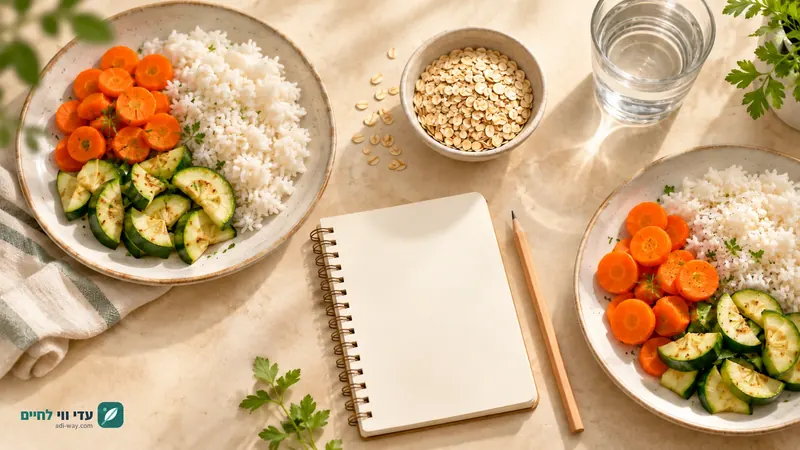
As I wrote in my response about fruit and vegetables, introduce these foods very gradually. Start with fruits containing soluble fiber, such as bananas, cucumbers, and peeled apples, and progress gradually. Steamed orange vegetables too.
The same goes for grains: try introducing oatmeal (finely rolled oats), as porridge or added to vegetable or chicken soup. Instead of white bread, try spelt.
Plant-based monounsaturated fats are easier to introduce: avocado and olive oil in reasonable amounts are usually well digested. If you notice pale, floating diarrhea (sorry for the detail) after fatty foods, you are probably still having difficulty digesting them, so reduce the quantity. With colitis, however, this is less common and they are usually well tolerated.
Good luck!
Answers to questions about spices for Crohn's and colitis:
The goal during a flare-up of inflammatory disease is to prevent any irritation of the inflamed area of the bowel.
Imagine you have a wound on your hand. Now imagine how it would feel if you put salt water or a lemon wedge on the wound, or sprinkled it with black pepper... Did you shudder? Understandably! If the thought of stinging and burning on an external wound puts you off, imagine what happens to the delicate, inflamed bowel lining. If there are also open, bleeding ulcers in the bowel, as in ulcerative colitis, seasoned, sour, and salty food is unlikely to do it any favors...
The first thing to do during a flare-up, then, is to prepare the simplest food possible andkeep seasoning to an absolute minimum. Bake potatoes, butternut squash, zucchini, and sweet potatoes in their skins, and eat them without any seasoning (I know this sounds very difficult, but from very personal experience, it takes a few days to get used to it, and you discover the food's natural flavor.
Make vegetable soup without salt and pepper, or with very little, and instead use celery, parsley, and dill tied together, solely for seasoning. It is also well worth avoiding onions and garlic, especially raw. Of course, remove sausages and pastrami, yellow cheese and Tzfat cheese, which are high in salt, soy sauce, and other store-bought sauces from the diet. Soup powders, whether natural or regular, are also best avoided.
I know it sounds difficult, but in my experience you get used to it fairly quickly, and most importantly, the bowel feels better!
Seasonings you can use in cooking: Turmeric, cumin, sweet paprika, nutmeg, dried celery and parsley, all freshly and finely ground into a powder. No raw onions or garlic, and avoid vinegar and lemon juice (apart from a little fresh lemon juice in fatty foods that provide a kind of lubrication, such as avocado and tahini). When cooking, use a bunch of parsley, dill, or celery, which is removed from the pot and discarded after releasing its aromas into the dish (and minerals, including magnesium). For sweetening I use honey, natural date syrup, a little brown sugar, natural vanilla extract, and finely ground cinnamon in cake.
Answers to Yehudit 5 and Avi88 about incorporating fruit and vegetables into the diets of people with IBD:
Fruit and vegetables in the diets of people with IBD are a complicated subject.
On the one hand, they contain plenty of dietary fiber and may therefore irritate the inflamed lining or cause a blockage when there is narrowing.
On the other, leaving fruit and vegetables out of the diet reduces the supply of essential vitamins and minerals, and of anti-inflammatory substances, such as the natural antioxidants and anticancer substances found in them. A lack of anti-inflammatory substances slows bowel healing, affects mental well-being (which also slows recovery), and does not help maintain stable remission over time.
My recommendation, therefore, is to do everything possible to include fruit and vegetables in the diet. Of course, this must be done gradually, in small steps, listening to the bowel's responses and progressing slowly.
Here are two simple ways to introduce fruit into the diet:
1. Make juice from carrots, pomegranates, sweet apples, and pears. You can also add cucumber and zucchini, whose flavors blend into the fruit. Start with a small amount, 1/2 cup a day, even diluted with water, and increase the quantity as tolerated.
2. Make a water-based fruit smoothie from seasonal fruit such as bananas, apples, and custard apples. Citrus fruit is usually too acidic and should be treated like spices (see the post on spices).
Again, everything should be done gently, in small quantities, and in line with digestive and absorptive capacity.
Aliza wants to know whether everyone with Crohn's and colitis has marked sensitivity to dairy products.
I would also appreciate hearing about coping with stress and tips for getting through such periods safely.
Indeed, many people with IBD are sensitive to milk and dairy products. Since the sensitivity can be to milk sugar (lactose) or milk protein (whey or casein), I recommend avoiding dairy products during a flare-up and the intermediate stage, until discomfort, pain, gas, and irregular bowel movements have resolved. The calcium missing as a result can be replaced with a supplement, preferably with vitamin D. For spreading on bread, use avocado or tahini; some people manage with a mild homemade pesto (without garlic).
As for ways to relax: Dealing with the limitations and difficulties this disease creates is certainly not simple. There are several things you can do. For now, I will address a very effective tip that works for many of my coaching clients: when you feel the pressure mounting, have no energy left, see no way out, or wonder why you should even bother if another flare-up comes anyway, and have other unpleasant thoughts like these, stop what you are doing. Sit somewhere quiet and comfortable. You can put on pleasant music and start breathing into your abdomen. Take deep breaths, the way children breathe. Hold for a few seconds and release slowly. Repeat 4 times, perhaps morning and evening. Tell me how it went J
A response to an 18-year-old "Crohn's patient" who complained of gaining 5 kg:
Hello, dear 18-year-old. I do not know what you weigh, but I find it difficult to imagine how gaining 5 kg would cause actual obesity. Obesity is indeed unhealthy for anyone, including people with Crohn's, so I recommend checking with a dietitian whether your weight is appropriate for your height. Because perhaps, just perhaps, what you are really describing is difficulty with body image? Perhaps you feel that your body is "betraying" you: developing a serious chronic disease and also gaining weight against your wishes. Suddenly going out is difficult, as are all sorts of things you enjoyed or planned to do. If that is how you feel, I understand; it really is not easy! In that case, I recommend making your diet healthier rather than more weight-reducing, an important difference. Also seek counseling or coaching, because facing this alone is very difficult and, in truth, unnecessary. I hope I have given you some directions to think about.
Ada55: I have had Crohn's for 30 years. I have had two operations to remove the terminal ileum. My diet consists of carbohydrates and proteins (no legumes, vegetables, fruit, or, of course, dairy products). I would appreciate updates or breakthroughs regarding nutrition, or alternatively which vitamins to take.
Hello, Ada55. As I understand the situation you describe, the main reason for avoiding fruit, vegetables, and legumes is fear of a blockage? This is a justified concern. At the same time, every living body needs all of these to function as healthily and properly as possible. No living body can go for years without vitamins and minerals and remain healthy. To reduce the risk of inflammation and, consequently, thickening of the bowel wall, all of these need to be included in the diet. I would not recommend eating persimmons or raw celery, because their insoluble fiber content is very high and the risk of bowel blockage is considerable, but there is a sufficiently wide choice of fruit and vegetables that can be eaten safely. Legumes are indeed relatively hard to digest, but whole grains can be introduced gradually and with appropriate cooking methods. You did not describe your bowel movements, so I cannot go into more detail. As a starting point, I refer you to my response on fruit and vegetables. In any case, I recommend doing this with professional guidance while paying attention to the bowel's responses.
Galgal1: What diet is recommended for colitis?
The confusion you describe is certainly familiar. I will try to address your question briefly to give you some directions to consider, since there is not enough space here for all the details about nutrition for colitis. The exploration of your own body that you have begun is welcome. I divide food's effects on the disease into 3 time frames:
- Immediate: how you feel immediately after eating a food, even while it is still in the stomach and far from the colon, can tell you a lot about its suitability. This may include abdominal pain, gas, discomfort, or simply heaviness.
- Medium-term: the effects of food you feel within 24-48 hours of a meal. Symptoms suggesting a food does not suit you may include heartburn, abdominal pain, and diarrhea (more than usual).
- Long-term: food has lasting effects. Some foods can promote inflammation, such as white flour and white sugar, while others can balance inflammation, such as omega-3, fruit, and vegetables.
I recommend taking this into account too as you search for a suitable diet.
Shlomit 79: Obesity and Crohn's.
You describe a reality that is not uncommon, although it receives less attention: Crohn's and obesity. About 50% of people diagnosed with Crohn's later in life have obesity. Obesity has been found to increase the risk of developing inflammatory bowel disease, and of course there is no dispute about its other harms, such as cardiovascular disease and diabetes. It may result from steroids or other medications. If you are in remission but your diet still lacks fresh fruit, vegetables, and whole grains, unhealthy weight gain is quite possible. I recommend starting to examine your diet and gradually adding fruit and vegetables, as in my post on that subject, while gradually reducing empty carbohydrates such as white bread and related products. And of course, sorry to repeat myself, work with a dietitian.
What is Celadrin, and is it effective forIBD?
A new Solgar product that boasts a blend of oils similar in effect to omega-3. There are no studies on inflammatory bowel disease (see the link), and I did not find any in a quick search of online libraries either. I do not have enough information to answer, but simple reasoning suggests: if it is similar to omega-3, why not take the original? Curcumin has also been found effective in balancing inflammation and preventing colon cancer.
This is general news information and is not a substitute for personal advice from a doctor or dietitian.