Nutrition for Remission in Crohn's Disease and Colitis
Adi Way Editorial TeamPublished:

How can nutrition help achieve and maintain remission?
Crohn's disease and colitis are much more common in the Western world than in developing countries. In Japan, for example, their prevalence until 20 years ago was about 1/3 of today's level. In Pakistan and Malaysia, doctors note that while people maintained their traditional diets, rates of Crohn's disease and colitis were significantly lower than among residents who had emigrated to Western countries. What is different?
- Life in the Western world, compared with the Third World, involves constant stress (distress), air pollution, little physical movement, and a diet entirely different from traditional food.
- The modern diet includes processed and industrially produced food, extensive use of preservatives, food coloring, pesticides, additives given to livestock (such as antibiotics and growth hormones), and meals at restaurants and food stands. Western food is also high in salt, and the most common cooking method is frying, which makes food rich in free radicals, substances that promote inflammation and cancer. Of course, excessive use of canned foods and industrial fats, such as margarine, hydrogenated fat, partially hydrogenated fat, or trans fats, "adds fuel to the fire." Last but not least is our widespread use of white flour and sugar products, which have been found to be directly linked to diseases of excess, such as diabetes, cancer, heart disease, and inflammatory bowel disease.
- To examine the relationship between these diseases and the characteristics of a Western diet more closely, a literature review is enough to reveal the following connections:
- Environmental factors, namely diet, antibiotic use, and stress, were found to have a greater influence on the onset of Crohn's disease or colitis than heredity 1. How do we know? A study of 500 pairs of twins, identical and nonidentical, found that eating processed meat (cold cuts, sausages, hamburgers, and so on) was one of the significant factors in the onset of the disease.
- Foods that increase the risk of another Crohn's or colitis flare-up again include red and processed meat products, snacks, baked goods high in white flour, sugar, and margarine, as well as low consumption of fruit and vegetables 2,3.
- A 10-year follow-up of 68 thousand women also found that the more animal protein they ate, especially meat and fish, the more likely they were to develop Crohn's disease or colitis 4.
- A study examining maintenance of remission in people with Crohn's disease showed success for more than 4 years through a diet low in white flour and sugar and rich, brace yourself, in fruit, vegetables, and natural whole grains (without artificial enrichment with bran) 5.
- And very recently, another study was published that supports all the findings above and, in my view, points the way toward the best diet for maintaining remission in Crohn's disease and colitis 6:
These are the main features of the diet in the study, which showed maintenance of 100% remission in people with Crohn's disease in the first year and 92% in the second:
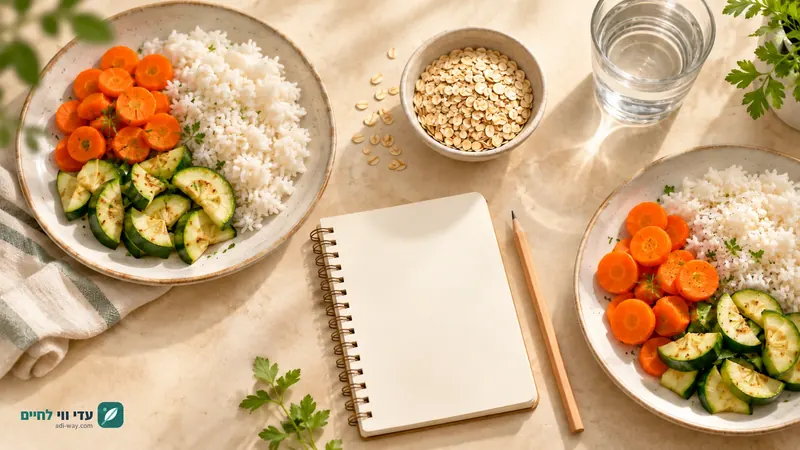
Grains: white rice in the first week, white rice mixed with brown rice in the second week, and brown rice from the third week onward.
Protein: tofu, an egg, plain yogurt, legumes.
One portion of fish a week, one portion of meat every two weeks.
Fresh and steamed fruit and vegetables.
The diet did not include: bread and products made with white flour and sugar, sweets, meat and processed meat products, cola and carbonated drinks, or sweetened drinks.
4. Gluten: real harm or myth?
As a clinical dietitian, I opposed the trend of eliminating gluten for weight loss for many years. Then I began studying the subject more closely and discovered very interesting connections between excess gluten and modern diseases. Why excess? Because today we eat a great many wheat products, and wheat is the grain richest in gluten. Gluten is the protein that gives bread its beautiful, tall structure, so many bakeries add extra gluten to their breads and rolls. Complete elimination of gluten is essential only in celiac disease. However, people with psoriasis, an autoimmune skin disease, have also been found to experience improvement when reducing gluten intake, and irritable bowel symptoms, such as gas, alternating diarrhea and constipation, bloating, and abdominal pain, also improve. Since many people with IBD experience irritable bowel symptoms, it would be natural to recommend reducing gluten consumption.
5. Dietary supplements: briefly, people with Crohn's disease and colitis have an increased risk of developing deficiencies and short- and long-term complications. Selected dietary supplements are therefore needed. Supplements to consider in Crohn's disease and colitis:
Anti-inflammatory supplements: curcumin, omega-3.
Correcting nutritional deficiencies: vitamin B 12, iron.
Preventing osteoporosis: calcium, vitamin D, magnesium.
Probiotics, mainly in colitis.
Achieving a healthy weight: medical nutrition.
Always consult a professional before purchasing or taking supplements!
In summary: 4 basic rules for nutrition during remission
- Choose foods that are easy to digest and rich in vitamins and minerals (natural juices, fruit, fruit smoothies, peeled or unpeeled, and easily digested, steamed vegetables such as pumpkin, carrots, zucchini, and potatoes).
- Avoid processed and industrially produced food: salt, preservatives, food coloring, pesticides, additives given to livestock, sausages and pastrami, fried foods, canned foods, industrial fats, sugar, and store-bought baked goods.
- Reduce animal protein, especially red meat.
- Start eating when you are slightly hungry and finish when you feel comfortably full, chewing thoroughly.
If you have not watched it above yet, you are invited to watch the online lecture about nutrition during remission, held on 04.12.12 in collaboration with the association supporting people with Crohn's disease and ulcerative colitis.
References:
- Spehlmann ME et al. J Crohns Colitis. 2012 Feb;6(1):29-42.
- Hou JK et al. Am J Gastroenterol. 2011 Apr;106(4):563-73.
- Jantchou P et al. Am J Gastroenterol. 2010 Oct;105(10):2195-201
- Morois Set al. Jantchou Am J Gastroenterol. 2010 Oct;105(10):2195-201
- Heaton KW et al. Treatment of Crohn's disease with an unrefinedcarbohydrate, fibre-rich diet. British Med J, 1979, 2, 764-766
- Chiba M et al. Lifestyle-related disease in Crohn’s disease: Relapse prevention by a semi-vegetarian diet. World J Gastroenterol 2010 May 28; 16(20): 2484-2495
This is general news information and is not a substitute for personal advice from a doctor or dietitian.