
A going-out bag: what to pack when your gut promises nothing
Adi Way Editorial TeamPublished:
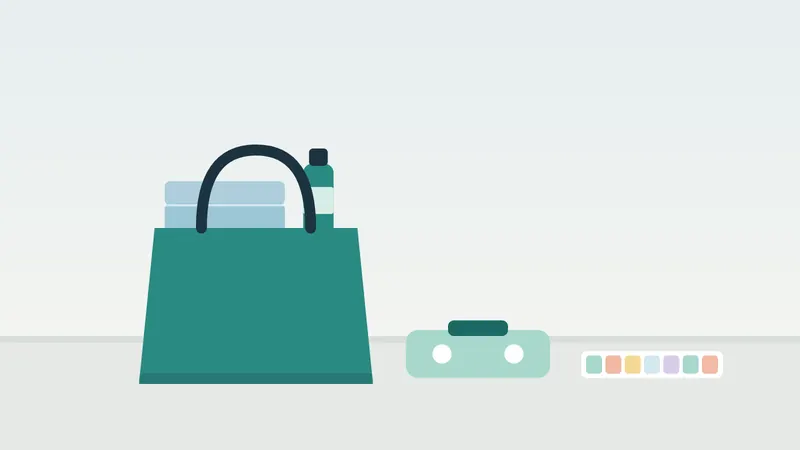
Fear of an urgent bowel movement shrinks your map. A going-out bag for a sensitive gut does not remove the fear. It lowers the cost of a mishap, which is what lets you go out anyway.
In brief: A going-out kit for a sensitive gut is a small pouch, not a backpack: a change of clothes, wipes, a bag, approved medication, water, and a snack. It does not remove the fear. It lowers the cost of a mishap, making it possible to go out.
The list
A change of underwear, a wipe, a bag, medication approved for this kind of day, a small bottle, a familiar snack. A card with your medication's name if you take it regularly. This fits in a side pocket, not a backpack for a school trip. If it is heavy, you will leave it at home, putting us back at the start.
Work
In a drawer, not on the desk. No one needs to see it. Bathroom access is a legitimate request without handing over your entire medical record. A sensitive-gut kit at work is worth more than a backup plan in your head, because what is in your head is not physically there when you need it.
Travel
Extra medication in your carry-on. Food for two hours. Check stops before committing to a nonstop bus. The bag does not replace route planning. It complements it.
After returning
Replace what you used that evening. An empty kit is a kit that does not exist. Check medication dates once a month.
Why a bag?
Fear of an urgent bowel movement works like a calculation: how likely it is to happen, and what it will cost. The likelihood is hard to change overnight. The cost can be changed.
A small kit turns a humiliating scenario into ten awkward minutes. That is enough to change the calculation and let leaving home win.
It works the other way too. Go out a few times with the kit and never need it, and you learn something no explanation could teach: that going out is possible. That learning does not happen at home while you hesitate. It happens outside, step by step, and every successful outing reduces the next hesitation.
How to pack it discreetly
An inner pocket in your everyday bag. An opaque, closed pouch. Clothes folded tightly in a sealed bag. No one needs to know what is inside, and no one will.
Do you switch bags? Prepare two small kits, one for each bag. That way the kit does not stay home on the day you need it.
What exactly goes in the pouch? Spare underwear, thin folded pants if there is room, wet wipes, a sealed bag for changed clothing, and a small bottle of hand-cleaning gel. A familiar nonperishable snack, such as crackers. A note with the name and dose of your regular medication. All this fits into a pencil-case-sized pouch. If it does not fit, something is unnecessary.
Medication, but only what is approved
Antidiarrheal medication can be part of the kit, but only if your doctor approved it for you and these situations. During active inflammatory bowel disease, taking it without guidance may be unsafe.
The same rule applies to every other pill in the bag: name, dose, and when it is permitted. A small note with instructions saves guesswork on a stressful day.
Another point: medications are sensitive to heat. A bag left in a car in August sunshine does not protect them. In summer, the bag comes inside with you rather than staying on the back seat.
Drinking on the way
Fear of bathrooms tends to make people drink less before going out. Understandable. And dangerous. A body that loses fluid without receiving any arrives weak.
A small bottle in the bag and sips along the way. We explained how much and what to drink when losing fluid in drinking when you are losing fluids: a calculation, not eight glasses.
A small snack along the way is part of the plan too. Leave on an empty stomach and you will later eat whatever is available, exactly when you have no control over the kitchen. A familiar cracker, a banana, something that has already passed your particular stomach's test. That keeps hunger from deciding for you.
The route matters as much as the kit
The kit does not replace planning. Know where bathrooms are along the way, in the mall, at the station. When traveling, choose an aisle seat. In an auditorium, sit at the end of a row.
When eating out, the kit and route work together with your food choices. We explained how to order without interrogating the kitchen in eating out without interrogating the kitchen.
Traveling by car? Bathrooms at gas stations, a planned stop roughly every hour if needed, and a driver who knows beforehand that you may ask to stop. No explanation is necessary. Asking is enough. A journey planned with stops is one you can take rather than cancel.
A kit for children
A child with a sensitive gut needs their own kit. Small, with contents they know, and without having to ask an adult for it. At school, activities, or on a trip.
Have one conversation in advance with the teacher or instructor so the child can leave the classroom without asking. The kit provides confidence. Permission provides freedom.
A school trip? Talk to the teacher a few days beforehand, not on the morning of the trip. What is in the kit, what the child can do independently, and whom to approach if something happens. A child who knows the adults know leaves on the trip with less fear. Sometimes that is the difference between a trip remembered fondly and one they do not want to join.
The kit at work
At work, the kit can stay in a permanent drawer rather than travel back and forth every day. A change of clothes, wipes, a bottle, a familiar nonperishable snack. Whatever runs out gets replaced that day.
If there is one colleague you trust, you can tell them briefly. Not the whole diagnosis, just what they need to know to help: if you suddenly leave a meeting, it is not because of them, and there is no need for questions. One sentence like that removes a lot of tension from the day.
Bathroom access? A legitimate request. A nearby seat, flexible breaks. A short doctor's letter helps when requesting an adjustment without handing over your entire medical record.
If you have not gone out for weeks
The kit will not be enough. At that point the fear is bigger than the symptom, and mental health support belongs alongside the dietitian and doctor. Equipment without one small outing remains equipment.
Common questions about a sensitive-gut going-out kit
How many changes of clothes? One set. More makes the bag heavy, and a heavy bag stays home.
What about traveling abroad? Extra medication in your carry-on, a doctor's letter in English for special medications, and a fully stocked going-out kit for every day.
How often do you check the kit? After every use, and once a month regardless. Expired medication does not help.
Does this perpetuate fear? The opposite. Knowing you are prepared makes you go out more. Going out more shows you that fear is bigger than reality.
What if a mishap still happens? It happens. That is exactly what the kit is for. Afterward, restock and carry on.
The information in this guide is general and is not a substitute for personal advice from a doctor or dietitian.



