What to eat on a flare-up day without turning it into a fast
Adi Way Editorial TeamPublished:
A flare-up changes the rules halfway through the game. What was fine last week is irritating today. Keep "eating clean" according to a post instead of eating what you tolerate, and you end up with nothing. Food during a bowel disease flare-up is measured by what stays down, not what looks right in a picture.
In brief: On a flare-up day, the goal is what stays down: fluids, small familiar portions, and protein when you can manage it. No experiments and no dieting. There are also red lines where you stop reading and make a call.
The goal for today
Fluids. Salt if you are losing it through bowel movements. Energy in small, repeated portions. Protein if you can manage it. Not variety. Not experimentation. A simple carbohydrate you already know, soft protein, moderate fat. Raw vegetables, peels, and whole fruit with plenty of fiber move aside until the wave subsides. This is not nutritional failure. It is a matter of priorities.
What a plate looks like
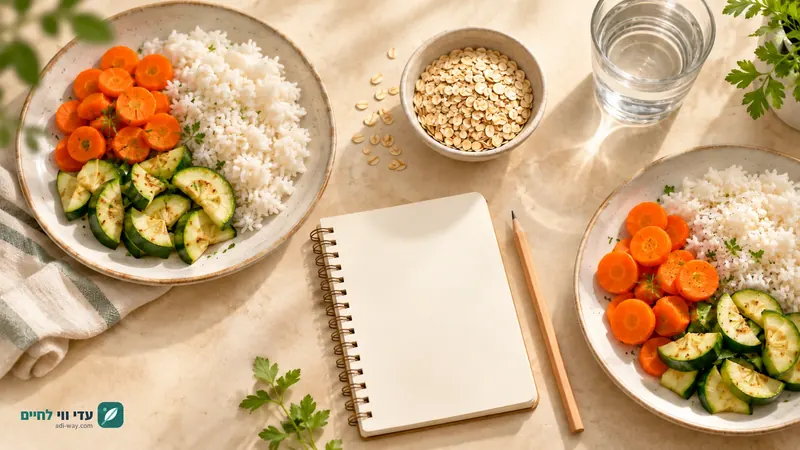
Half a cup of rice, an egg or shredded chicken, a little oil. Strained soup if chewing is difficult. A banana or puree if those work for you on bad days, not because every guide says so. If something that soothes other people makes you bloated, leave it out. Food during a bowel disease flare-up varies in its details but follows the same principle: small, familiar, repeated.
Drinking without overloading
Take sips throughout the hour. Water, soup, sometimes a solution with a little salt if your doctor or pharmacist has approved that approach. For some people, a large bottle all at once comes back as another bowel movement. Alcohol, a second coffee, and a large sugary drink are not part of this day's comfort.
What not to do about your weight
Do not celebrate weight loss. Do not start a diet because your pants are loose. Here, the drop is a loss, not an achievement. When the wave subsides, return to regular meals slowly, without a sudden attempt to "make up for it."
Why this is exactly the wrong time to try something new
A flare-up is the worst time to discover something. Every symptom looks like a reaction to food, even when it is actually the disease.
Try a new food on a day like this and you will blame it. Then remove it from your diet for years. Without a reason. Hence the rule: during a flare-up, stick to the familiar. Experiments wait for a quiet week, when a reaction means something.
The same applies to supplements. Buy a new probiotic in the middle of a flare-up and feel better a week later, and you do not know whether it was the supplement or the wave passing. Feel worse and you will blame it without knowing. A flare-up is noise. You cannot listen to experiments in the middle of noise.
The clock, not your appetite
Appetite is unreliable during a flare-up. It disappears, then returns all at once at ten at night in front of an open refrigerator.
So eat by the clock. Something small about every three hours. A few spoonfuls of rice. An egg. Yogurt, if it works for you. This sounds mechanical. That is precisely the point. A body that receives a small, steady amount copes better than one that receives nothing and then a lot.
A small tip that makes a difference: prepare ahead. A container of cooked rice in the refrigerator, hard-boiled eggs, soup in a pot. When your energy runs out, you do not start cooking. You open and heat. During a flare-up, every step you save is a bite you manage to eat.
Protein: the bite you do not give up
When the gut burns, muscle pays the price. Inflammation breaks things down, and the body takes from what it has.
So even on a bad day, try to get a little protein in each time: an egg, shredded chicken, soft cheese, thick soup. Not a trayful. A bite. We explained how to do this when you have no appetite at all in protein when you have no appetite: how to avoid losing muscle.
Fluids that stay down
The gut is losing fluid, and the body is waiting. Small sips throughout the day are better than one large glass every two hours.
Strained soup provides both fluid and salt. If you are losing a lot, ask your care team about a rehydration solution. We explained how to work out what you have lost and what needs to go back in in drinking when you are losing fluids: a calculation, not eight glasses.
The night afterward
There is no rest at night during a flare-up. Bowel movements, pain, thirst. So prepare for it in advance.
A glass of water beside the bed. Something small and familiar in the refrigerator for when you wake up hungry. And a notebook nearby, because what happened at three in the morning will be forgotten by morning. It is exactly what the doctor will ask about.
If the night has already gone badly, start the morning slowly. A glass, a bite, and only then a decision about the day. Do not plan a full day after a night with three bowel movements. Plan the next two hours.
The household
Whoever cooks at home needs to know one thing: this week, the food for the person having a flare-up is simpler. That is all. There is no need to change everyone's kitchen or argue over every plate.
A basic shared pot, additions on the side, and a small portion set aside for when appetite returns. The household keeps going. The plate adjusts.
What if you live alone? Prepare a smaller version of the same idea: meals frozen ahead, waiting for days like these. In a good week, cook twice as much and freeze half. In a bad week, that half is a meal you do not have to stand up to prepare.
When the wave starts to subside
One morning, something changes. Fewer bowel movements, a little appetite, enough energy to stand at the stove. The trap arrives at exactly this moment: making up for what you missed. A large meal, a salad, something you have been craving.
Not yet. The wave is subsiding, but the tissue is still sensitive. Add one thing each day, in a small amount, and check. Protein first, then another carbohydrate, and only at the end raw vegetables and fruit with the peel.
Jumping ahead will not always take you back to the starting point. But it certainly wastes days. A week of patience sometimes saves two weeks.
A red line
Heavy bleeding, dizziness when standing, vomiting that prevents drinking, fever, unfamiliar sharp pain. That is when you call your care team or the emergency department, rather than look for another recipe. A guide does not replace someone who knows your medical record.
Common questions about food during a bowel disease flare-up
Should you switch to a liquid diet? Sometimes the care team recommends medical nutrition drinks for a certain period. That is their decision, not a social media post's.
How long does the limited menu last? Until the wave subsides. Then return gradually, not in one day.
Is coffee allowed? If it speeds up your bowel movements, not on this day. If it does not, one cup after food.
What if you cannot eat anything all day? That is no longer a matter for a guide. It means calling your care team.
Can you eat fruit? Many people tolerate cooked, peeled, or mashed fruit better than whole raw fruit. Bananas and applesauce are familiar starting points if they work for you.
What about dairy? If it was not a problem before the flare-up, you do not necessarily have to remove it now. If it speeds things up, it waits for a quiet week.
When do you return to normal eating? When bowel movements settle, pain eases, and appetite returns. Gradually. A separate guide awaits you later.
The information in this guide is general and is not a substitute for personal advice from a doctor or dietitian.