Packed Lunches for a Sensitive Gut: Four Meals Without a Test Kitchen
Adi Way Editorial TeamPublished:

A cafeteria, a delivery driver, and "whatever is in the office refrigerator" are three sources of surprises. With a sensitive gut, a surprise sometimes means an hour in the bathroom in the middle of an already packed day.
A lunchbox from home sounds like a Sunday-evening chore: recipes, ingredients, dishes. In practice, it can be four meals repeated again and again, without a cooking blog or special creativity. The goal is not a meal that impresses in the office kitchen. It is a meal that brings no surprises.
Why lunchtime falls apart
In the morning, most people eat at home or do not eat at all. In the evening, there is a kitchen. Lunch is the gap: a time when you are hungry, rushed, and dependent on what is nearby. Nearby food is usually designed for a broad audience: rich sauces, onion and garlic as the base of almost every dish, large portions. There is nothing wrong with that. It was simply not designed for a sensitive gut.
What goes into a lunchbox you can tolerate
A carbohydrate already tested: rice, a potato, or bread familiar from your diary. A simple protein: an egg, chicken, tolerated cheese, or legumes only if they have already passed a symptom-free week. A cooked vegetable, which many people digest more easily than a raw one. And sauce on the side, always on the side, because plenty of oil, onion, or garlic in a sauce is often the troublesome ingredient, not the chicken.
Four meals like this in rotation cover two weeks without much thought.
Four sample lunchboxes
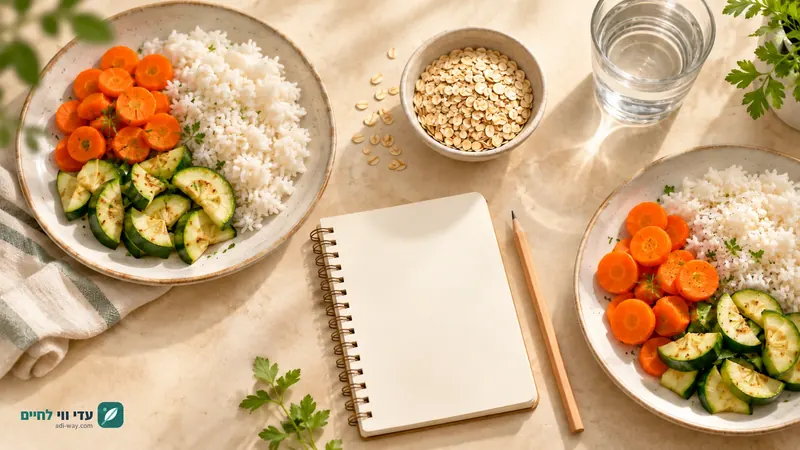
Rice, baked chicken, cooked zucchini, and sauce on the side. A potato, a hard-boiled egg, and cooked carrot. A sandwich on tested bread with tolerated cheese and cucumber wedges. And strained vegetable soup with crackers for days when your stomach needs something gentle.
These are not menus recommended for everyone. They illustrate a structure: a familiar carbohydrate, a simple protein, and a vegetable in a tolerated form. Everyone swaps ingredients according to their own diary. The principle remains: four options, not forty.
A day when your stomach is not cooperating
Some mornings, it is already clear that the day will be sensitive. A smaller lunchbox or soup prepared ahead is better than skipping food until four in the afternoon and then eating office cookies. Skipping may sound protective, but in practice it brings intense hunger and a meal eaten too quickly.
Keep a backup food at work that does not depend on the shared refrigerator: tested crackers, a fruit, something dry and familiar in a drawer. We discussed the afternoon gap and how to fill it without sweets in The four o'clock snack.
Colleagues and "just one bite"
Colleagues do not need to know your diagnosis. They do need to stop offering "just one bite" of everything they order. A short, polite sentence is enough: "Thanks, I am sticking to my own food today." No medical explanation is needed in the middle of a team meeting. If someone insists after that, the problem is theirs.
Preparation without cooking every evening
Cook double on one day: rice for three days, protein for two, and vegetables on the day you eat if texture matters to you. Freezing small portions prevents the familiar pattern of food becoming tiresome on day three and being thrown away on day four.
If preparation itself is the obstacle, a purchased meal with a short ingredient list is better than no lunchbox. Perfection does not reach the office. What gets there wins. We detailed a regular shopping list that fills this lunchbox without new experiments each week in Weekly shopping when you have a list of sensitive foods.
A refrigerator, a cooler, and a microwave
Cooked food sitting in a bag for hours in the Israeli heat is no longer the same food. If there is no refrigerator, use a small cooler with an ice pack. If there is a microwave, heat the meal until it is hot throughout, not just at the edges. A sensitive gut does not need another variable, especially one caused by food that spoiled on the way.
What to record if symptoms still appear
What was in the lunchbox. When you ate. Whether there was also stress that day, or coffee on an empty stomach. Without a record, one bad day leads you to replace the whole approach. With a record, you change one ingredient.
That is the entire difference between a new diet every week and a diet you can live with.
This is general news information and is not a substitute for personal advice from a doctor or dietitian.